A war meant to bend Tehran now traps Washington
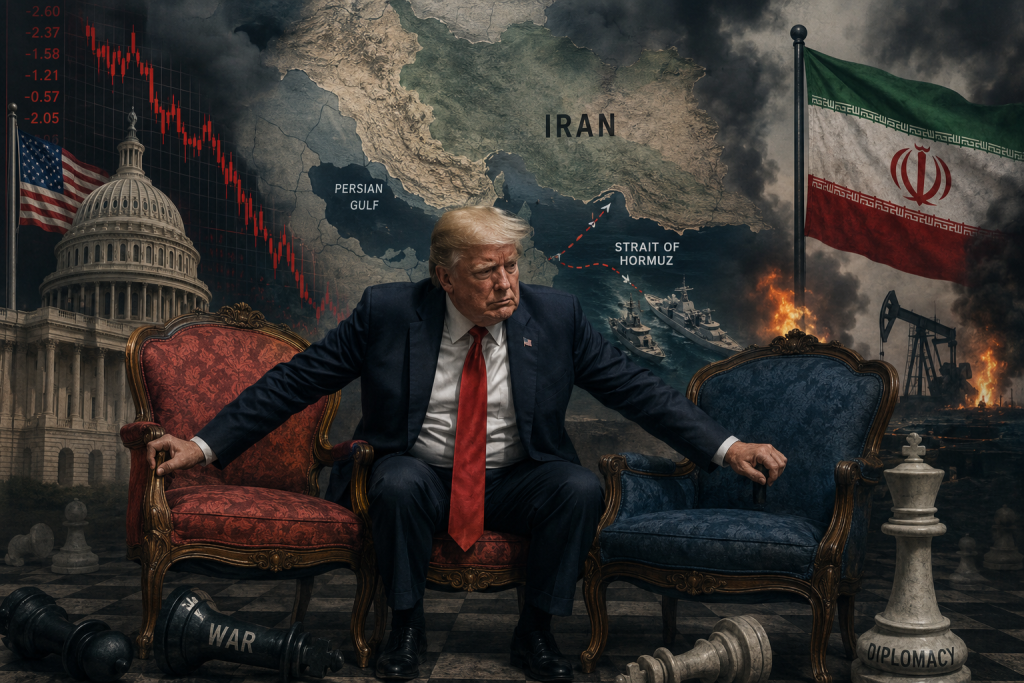
The Iranian crisis now carries all the familiar features of recent Western wars: overwhelming technological superiority, deep-strike capabilities, enormous military spending and, at the same time, uncertain political results, sometimes opposite to the stated goals. The United States has attacked Iran, claimed the destruction of installations, missile capabilities, infrastructure and military assets, yet it has not obtained the essential result: Iran’s strategic submission.
This is the central paradox. Washington may claim to have destroyed most of Iran’s military potential. But even a residual capacity for resistance is enough to prevent the United States from proclaiming a real victory. In war, what matters is not only what has been destroyed, but what the adversary still retains in order to negotiate, strike back, resist or apply pressure. Iran, despite the damage suffered, still holds major cards: internal political cohesion, residual missile capability, the Strait of Hormuz, regional influence, the experience of decades of sanctions and a population that, in the face of foreign attack, tends to rally around the state.
Trump therefore finds himself in an uncomfortable position. He must show that he has won, because he cannot admit to having spent more than one hundred billion dollars for a strategically empty result. Yet he must also exit the war, because the conflict is unpopular in the United States, disturbs the markets, weighs on the American economy and contradicts his electoral promise not to drag the country into new Middle Eastern adventures. He is, quite literally, sitting between two chairs: on one side, the need to save face; on the other, the need to stop the political and economic bleeding.
The cost of the operation and the emptiness of victory
The war has already produced a very high military and financial cost. According to the available reconstruction, the United States has lost or seen damaged several air assets, while the overall cost of the operation has exceeded one hundred billion dollars. That figure is politically devastating because it raises a simple question: what was obtained in return?
Strategically, the answer is not favorable to Washington. Infrastructure has been destroyed, targets have been hit, civilians have been killed, hospitals have been damaged and the humanitarian crisis has worsened, but Iran has not been defeated. Its political command has not collapsed. The system has not disintegrated. Iranian institutions, even if contested by part of society, have not been overturned by the military shock. On the contrary, the external attack has produced a predictable effect: it has strengthened the national reflex.
This is a recurring mistake of Western powers: the belief that bombing a country will automatically provoke a popular revolt against its government. More often, the opposite occurs. Those who may criticize their own rulers do not necessarily accept seeing their country struck by a foreign power. War, especially when perceived as aggression, transforms dissent into national defense. This has happened elsewhere, and it is happening again with Iran.
American threats: pressure on Tehran and sedative for the markets
Trump’s threats now serve two purposes. The first is diplomatic: to pressure Iran into accepting conditions defined by Washington. This is the logic of negotiation under coercion, the old principle according to which diplomacy comes after the demonstration of force. The second is economic: to reassure the markets.
This point is decisive. The Iranian war is not only about the Middle East, Israel or the nuclear program. It is about energy prices, maritime routes, shipping insurance, stock markets, inflation, investor confidence and therefore the internal strength of the American economy. Trump knows that a prolonged crisis in the Strait of Hormuz can directly hit American citizens through fuel prices, transport costs, goods and the entire production cycle.
That is why he repeatedly announces agreements, ceasefires, diplomatic openings and imminent solutions. But the repetition of such announcements also reveals their weakness. If an agreement must be proclaimed many times, it means it has not really been reached. Diplomacy becomes theatre: it buys time, contains panic and creates the impression that Washington still controls events.
Hormuz, from maritime passage to strategic lever
The Strait of Hormuz is the geoeconomic heart of the crisis. Before the American attack, the passage was essentially open. After the escalation, Hormuz became Iran’s main instrument of pressure. Washington now demands its full reopening because it knows that uncertainty over that route can inflame the global energy market.
Tehran reasons differently. It does not see Hormuz merely as a commercial corridor, but as a lever of sovereignty. If Iranian territory has been attacked, and if regional countries have offered bases, airspace or logistical support to the United States, then Iran believes it can impose conditions on transit. This includes the idea of payments or compensation to help finance reconstruction after the damage suffered.
Here we see the transformation of contemporary war. It is no longer enough to control the skies or strike military depots. One must control routes, flows, currencies, insurance premiums and supply chains. Hormuz becomes a battlefield without trenches: whoever conditions it can influence the global economy. Iran does not intend to give away that card for free.
The fourteen-point plan: two irreconcilable logics
Negotiations revolve around a fourteen-point plan, but the American and Iranian versions appear to be built on opposing logics. The United States wants a ceasefire first and negotiations afterward. It is the scheme already seen in other crises: stop the fighting, freeze the military balance and then discuss political terms.
Iran rejects this approach. Tehran wants a cessation of hostilities embedded in a broader negotiated framework, with precise guarantees. The difference is essential. For Iran, a simple ceasefire could be only a tactical pause useful to the United States and Israel for reorganization. A true cessation of hostilities must instead mean the end of war, reciprocal obligations, verifiable commitments and international legal protection.
This is why Iran wants any agreement validated by the United Nations Security Council and by the Board of Governors of the International Atomic Energy Agency. Tehran does not want an American promise, because it does not trust American promises. It wants an international constraint, knowing that Washington has already signed agreements only to empty them of substance or abandon them.
Sanctions, frozen assets and financial warfare
The sanctions chapter is perhaps the most revealing. The United States wants to lift sanctions only after Iran has respected all obligations under the agreement. In practice, Tehran must concede first, and Washington may later ease pressure. Iran demands the opposite: sanctions relief must be part of the agreement, not a future reward.
The reason is simple. Tehran has lived under sanctions for roughly half a century. It has learned that sanctions are not merely diplomatic instruments, but a form of permanent war. They strike the population, the currency, imports, health, industry, technologies and daily life. They are not a surgical weapon against political leaders; they are an economic siege against the whole country.
This also explains Iran’s demand to unlock frozen assets abroad, estimated at about twenty-four billion dollars. These are sovereign resources belonging to the Iranian people, and Tehran refuses to let Washington use them as political hostages. The same dynamic has been seen with other sanctioned countries, from Venezuela to Russia. The West financializes conflict, freezes assets, blocks reserves and turns the banking system into a weapon. Yet this strategy also produces a long-term effect: it pushes targeted states to seek alternatives to the dollar and to Western-controlled institutions.
Reconstruction, non-interference and regional military presence
Another point bound to irritate Washington concerns reconstruction. Iran asks the United States and its allies to present a plan to repair the damage caused by the war, with a figure mentioned in the range of three hundred billion dollars. For Washington, such a request is almost politically unacceptable because it would imply direct responsibility for the devastation inflicted.
Tehran also demands a commitment from the United States not to interfere in Iranian domestic affairs. This issue reaches deep into the history of US-Iranian relations. After the Iranian Revolution and the hostage crisis at the American embassy in Tehran, the Algiers Accords already included an American commitment not to interfere in Iran’s internal affairs. From Tehran’s point of view, that commitment was never truly respected.
Iran accuses the United States of continuing to finance opposition networks, support hostile groups, encourage separatist or armed movements and maintain indirect pressure. For Tehran, the war did not begin with the bombings. It is a long war made of sanctions, covert operations, support for opposition forces, destabilization and military pressure in the Gulf.
The American military presence in the region is another crucial point. Iran rejects any increase in the US military deployment and, in a more radical formulation, sees the entire American presence in the Gulf as destabilizing. Even some Gulf states, despite being Washington’s partners, fear being dragged into a wider regional war. They need American protection, but they also fear paying the price if they become operational platforms against Iran.
Nuclear file and missile deterrence
The nuclear issue remains the official argument of the crisis. Washington says it wants to prevent Iran from acquiring nuclear weapons. Tehran replies that it does not seek such weapons and that its activities remain within the framework of the Non-Proliferation Treaty. If that is the case, the nuclear issue appears less technical than political. The real aim would not only be to prevent a bomb, but to limit Iranian strategic sovereignty.
Iran claims the right to enrich uranium for civilian and commercial purposes. Enrichment at sixty percent is presented as a response to pressure, assassinations, sabotage and attacks suffered over the years. Tehran wants this right explicitly recognized in the agreement, not treated as a revocable concession.
But the most sensitive point is the ballistic missile program. Iran excludes it from negotiations. The reason is strategic. Without nuclear weapons, Tehran considers missiles its only real deterrent against Israel and the United States. They are the minimum guarantee that the country cannot be struck without response.
For Washington and Israel, those missiles are precisely the problem. Not because they are necessarily a decisive offensive weapon, but because they make any future aggression more costly. A power becomes truly vulnerable when it can be hit without consequences. Iran wants to avoid that condition. Reducing or eliminating its missiles would expose the country to new air campaigns, new bombings and new decapitation operations.
The final trap
Trump’s situation resembles a strategic trap. If he continues the war, he risks increasing costs, losing domestic support, alarming markets and dragging the United States into a wider regional conflict. If he stops without obtaining decisive concessions, he will appear defeated. If he signs an agreement too favorable to Iran, he will be accused of weakness. If he demands too much, Iran will not sign.
Tehran, although hit, is less hurried. It is accustomed to sanctions, knows Western pressure and understands that time may work in its favor if international markets grow nervous and American public opinion tires of the conflict. Washington, by contrast, needs a quick and presentable result.

Be First to Comment