No Longer a Local Crisis, but a Fracture in the System
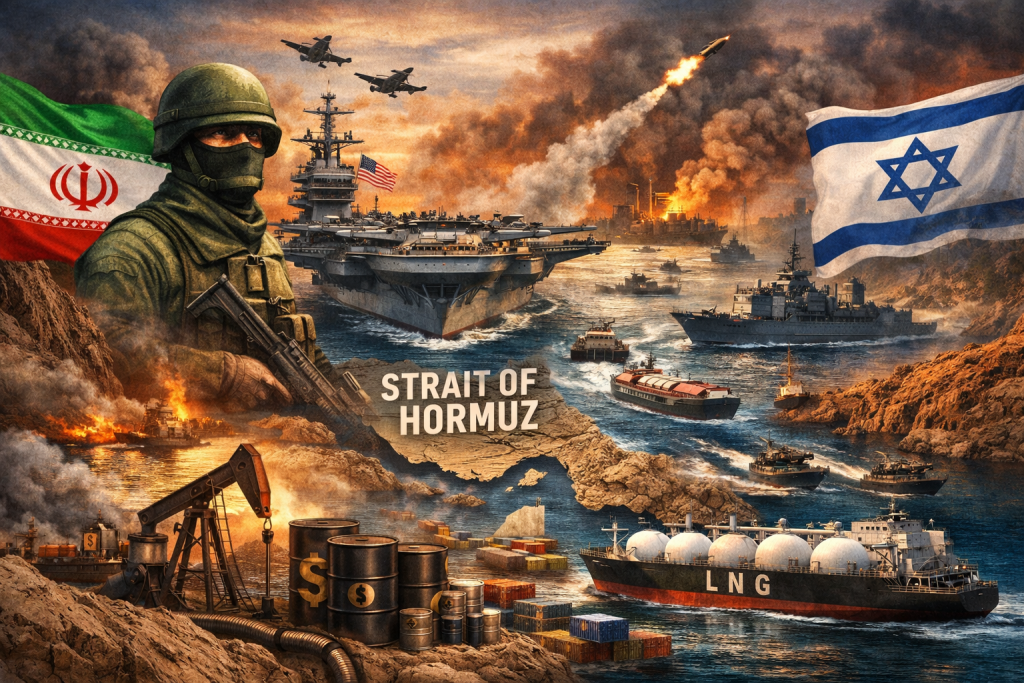
In the Western narrative, the war against Iran was supposed to be rapid, surgical, almost didactic: a few well-placed strikes, some infrastructure hit, a destabilized chain of command, and the usual belief that technological and military pressure is enough to break an adversary’s political will. Instead, the opposite is happening. The more the attack expands, the clearer it becomes that Washington and Tel Aviv have not opened a controlled military episode, but a systemic crisis bound to hit energy, logistics, finance, maritime transport, and regional balances of power. The issue is not merely that Iran is holding. The issue is that Iran has turned the Strait of Hormuz from a strategic passage into an instrument of geopolitical command.
The fundamental American and Israeli mistake was to imagine Iran as a fragile structure, hollowed out from within, destined to bend under the weight of targeted killings, bombings, and psychological shock. It is the same illusion the West has cultivated in other theaters: the idea that the enemy appears powerful until the first blow, only to reveal itself as empty. But Iran did not appear as a state on the verge of collapse. On the contrary, under attack, it recovered a political, social, and symbolic cohesion that in earlier phases had seemed far weaker. War did not dissolve its internal order. It strengthened it.
The Attack on Infrastructure and the Boomerang Effect
The most serious escalation has been the extension of the conflict to energy infrastructure. Striking the Iranian side of South Pars does not simply mean damaging a facility. It means hitting the material core of the electric, industrial, and civilian supply system of a country that has spent years preparing for a long confrontation. Yet the impact of this move did not stop at Iran. It reached Qatar, shook the regional gas balance, injected panic into the markets, and opened a crisis far broader than those who thought they could use energy as an instrument of intimidation had imagined.
This is where the geoeconomic knot lies. When war begins to hit structures that require years to rebuild, special steels, complex industrial chains, and enormous capital, conflict ceases to be a military episode and becomes long-cycle destruction. It is no longer the present alone that is being struck. The future itself is being consumed. And this is exactly what markets refuse to see every time they cling to reassuring statements from the White House. Every promise of a short war, every slogan about imminent success, may work for a few hours on the exchanges, but it does not alter material reality: energy flows are vulnerable, maritime insurers change their behavior, costs rise, and systemic risk accumulates.
Europe, as so often happens, is the part of the Western system most exposed and yet the most powerless. For Washington, rising fuel prices are a matter of domestic political consensus. For Europe, they are an industrial, energy, and social threat. Every shock in the Gulf translates for the continent into higher costs, supply uncertainty, and new pressure on production chains. The war therefore shows, once again, that European sovereignty in energy matters remains largely a rhetorical fiction.
The Real Surprise: Iran Is Not Closing Hormuz, It Is Administering It
The common representation speaks of a possible closure of the Strait of Hormuz as if it were an absolute gesture: open or closed, free or blocked. But Iran’s novelty is more sophisticated, and therefore more dangerous. Tehran does not seem focused only on interdiction. It appears to be moving toward selective regulation of traffic. This is a major leap. It means replacing the Western principle of freedom of navigation with a conditional freedom, controlled and authorized by the actor that physically dominates the choke point.
If this pattern consolidates, Hormuz will no longer be merely a threatened strait, but a hierarchical corridor. Passage will be granted to those who are authorized, those who adapt, those who do not take part in aggression against Iran, those who accept new rules of payment, certification, and political alignment. This would no longer be episodic retaliation, but the birth of a new regional maritime regime. In other words, Iran would not use Hormuz only to punish. It would use it to govern.
And this is where the geoeconomic dimension intersects with the monetary one. If privileged transit were reserved for cargoes settled outside the dollar circuit, the blow would not concern tankers alone. It would strike at the energy paradigm built for decades around American naval protection and the centrality of the dollar. It is one thing to sell oil or gas within a system protected by the United States. It is another to enter a system in which the security of passage depends on accepting rules set by Iran. The stake would no longer be only freedom of trade, but sovereignty over the rules of trade.
Western Naval Superiority Breaks Against Geography
For more than a century, the West has based its power on control of seas, canals, choke points, and routes linking oceans, goods, and empires. From the British tradition to American hegemony, maritime power has meant the ability to interdict: to let pass those it prefers and block those who challenge the imposed order. Panama, Malacca, Suez, Gibraltar, Bab el-Mandeb, the Baltic, the Arctic: the whole modern strategic history revolves around this. But Hormuz is now showing the other side of the principle. Whoever controls the choke point from land can degrade the naval superiority of whoever dominates the open sea.
Geography helps Iran in a brutal way. In the narrowest and most sensitive section, Tehran has territorial depth, relief, artillery, missiles, drones, fast attack craft, small submarines, and submerged or semi-submerged platforms. It does not need to confront the American navy head-on in open waters. It only needs to turn the passage into a firing chamber. This is the classic logic of asymmetric warfare: not to annihilate the enemy’s power, but to render it ineffective at the precise point where its mass can no longer translate into freedom of action.
That is why the idea of “militarily opening” Hormuz through an amphibious expedition looks closer to propaganda than strategy. Landing limited contingents in an environment dominated by Iranian fire would mean exposing men and materiel to a system Tehran has been preparing for years. The Iranian coastline relevant to controlling the strait is wide, articulated, and covered by dispersed systems that are difficult to neutralize in full. To think the problem can be solved with a few thousand men is to have understood neither geography nor war.
Iran Plays for Time, the West Wears Itself Out in Haste
Iran’s advantage is not only technical or geographical. It is temporal. The United States and Israel acted as if the conflict were to be consumed in a matter of days. They built logistics, narrative, and expectations around a short war. Iran, by contrast, has spent years thinking in terms of a long war. That changes everything. The side prepared for duration rations its resources, preserves its most sophisticated systems, calibrates pressure, and waits for the moment when the adversary begins to suffer from the depletion of interceptors, munitions, psychological resilience, and political consensus.
In this framework, missiles are not merely weapons. They are instruments for eroding confidence. Every attack that slips through defenses, every night spent in shelters, every act of censorship designed to minimize internal damage produces attrition. Israel seeks to conceal its vulnerability, but vulnerability continues to work regardless. A society convinced of its strategic superiority can tolerate limited losses. It struggles far more when it discovers that the adversary is not disintegrating and that the promised victory keeps being postponed.
This is precisely Israel’s intelligence error: confusing tactical knowledge with strategic understanding. One may identify targets, strike senior figures, damage installations, but if one misreads the political nature of the state being attacked, the result is the opposite of what was intended. The belief that removing certain top leaders would trigger Iranian collapse has turned out to be a faulty diagnosis. And every faulty diagnosis in war is paid for with an expansion of the crisis.
The American Fracture and the Risk for Israel
On the geopolitical level, the war opens a second fault line, this time within the Western camp itself. In the United States, the conflict with Iran risks turning into a political confrontation between those who place American national priorities at the center and those who see Israel as the untouchable pivot of Middle Eastern order. As long as the intervention remains aerial, technological, and narratable as a show of force without direct human cost, the fracture can be contained. But a shift toward troops on the ground would change the nature of the crisis. At that point, the conflict would cease to be a war of screens and become once again a war of coffins, budgets, public opinion, and internal ruptures.
For Israel, the risk is double. On the one hand, it must continue to show that victory is near, because its political stability depends on the idea that escalation will produce a historic outcome. On the other hand, it depends on the continuity of American commitment. But if in the United States the alliance with Israel begins to be perceived as a drag into a poorly prepared war, Israeli security enters a new zone of instability. Not because Washington would suddenly abandon Tel Aviv, but because support would cease to appear unquestionable.
The Western Maritime Order Is Being Tested
Ultimately, the issue is not only military. It is the survival of an order. For decades, the West has taken for granted that the major energy and trade routes would be protected by its naval power, its finance, its insurance systems, and its law. Now, at one of the most sensitive points on the planet, an actor emerges saying the opposite: the route remains open, but on my terms. This is a radical challenge not only to Washington, but to the entire way the West has thought about globalization.
Iran, in short, is not merely reacting to aggression. It is trying to demonstrate that real power in the twenty-first century no longer lies only in bombing, but in deciding who may trade, in which currency, along which corridor, and under whose protection. If this dynamic consolidates, Hormuz will become the laboratory of a new war of sovereignty: no longer only the war for oil, but the war for the rules that make oil into power.
And this is precisely what Washington and Tel Aviv continue to refuse to see. They believed they could force Iran into submission. They may instead have offered it the historic opportunity to redefine, under the fire of war, the political architecture of global energy.

Be First to Comment