Hitchcock’s Decline and the CIA’s Intervention
In 1968, the career of British filmmaker Alfred Hitchcock seemed to be nearing its end. After the lukewarm success of Marnie (1963), his next film, Torn Curtain (1966), starring two of the highest-paid actors of the time, Paul Newman and Julie Andrews, turned out to be a near-commercial failure. At a time when Hitchcock despaired of finding new financing, Universal, which had previously shown little interest in continuing its collaboration with him, suddenly agreed to support a new project.
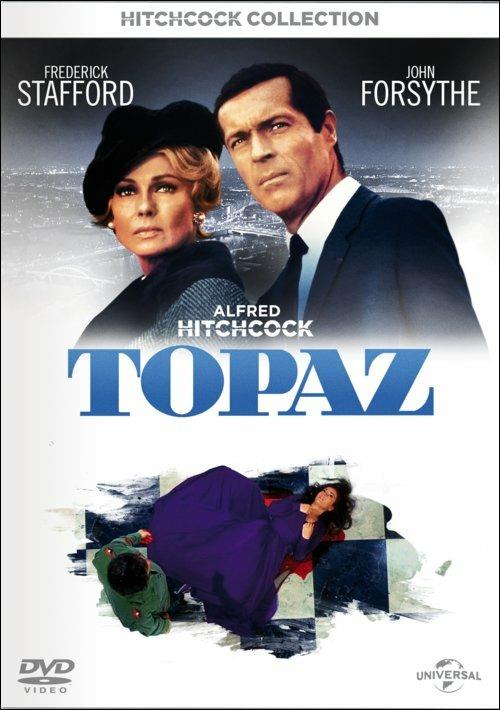
It was Leon Uris, author of the bestseller Exodus (1958)—a novel that inspired the eponymous film directed by Otto Preminger—who saved the situation. In 1967, Uris published Topaz, a novel inspired by the fictionalized memoirs of Philippe Thyraud de Vosjoli, a former French secret agent who had sought refuge in the United States in 1963. This text, supervised by the CIA, became the basis of a Hitchcock film, designed and orchestrated by American intelligence as a propaganda tool.
Topaz: A Novel and a Propaganda Film
Topaz recounts, in a fictionalized manner, the activities of French counter-espionage, highlighting alleged Soviet infiltrations in Charles de Gaulle’s government. The CIA sought to discredit the Gaullist regime and reinforce the idea of a France compromised by the KGB. For the first time in his career, Hitchcock was completely excluded from the screenplay writing process, which was directly overseen by the trio of Angleton, Vosjoli, and Uris.
When the film was released in the United States in 1969, a few months after de Gaulle’s departure from the presidency, Topaz garnered significant interest as a propaganda tool but failed as a cinematic success. Le Monde declared it “not a masterpiece” and noted that even Hitchcock could make mistakes. However, the film contained effective subliminal messages: the Soviets were portrayed as an omnipresent threat, and the film ended with a military march by Maurice Jarre that evoked the Soviet Union.
Golitsyn: The Soviet Defector and His Fantasies
At the center of the operation to discredit France was Anatoliy Golitsyn, a KGB defector who had been welcomed to the United States by the CIA. While Golitsyn initially provided valuable information, he soon began mixing reality and fiction. In 1962, he went so far as to claim that he was the son of Tsar Nicholas II, miraculously spared during the assassination of the imperial family. Despite a psychiatric report labeling him paranoid, the CIA, and particularly James Angleton, exploited his statements to accuse senior French officials of being Soviet agents.
Golitsyn’s accusations formed the basis for a letter President John F. Kennedy sent to de Gaulle, warning him about the presence of moles within his government. However, an investigation by the SDECE (French intelligence services) revealed the inconsistency of Golitsyn’s claims, as he was unable to provide concrete evidence or names.
The Manipulation of May 1968
Amid the May 1968 revolts, the French government suspected foreign forces of fueling the crisis. Georges Pompidou publicly stated that individuals with considerable financial resources were seeking to destabilize the country. Intelligence reports indicated that funding came from Cuba, China, Israel, and even the United States.
Specifically, the CIA allegedly supported Trotskyist and libertarian groups, such as the March 22 Movement led by Daniel Cohn-Bendit, to create chaos and weaken de Gaulle. Despite these suspicions, evidence was scarce, and the accusation of American intervention was dismissed by many as Gaullist paranoia. However, some intriguing facts, such as Cohn-Bendit’s exfiltration from Germany with the help of Paris Match, fueled theories of external manipulation.
De Gaulle’s Resilience and the Failure of Propaganda
Despite international pressure and internal revolts, de Gaulle managed to turn the situation around. On May 30, 1968, after a radio address announcing his intention to stay in power, one million people gathered on the Champs-Élysées to support him. The subsequent elections secured a landslide victory for the Gaullists, demonstrating the General’s resilience and the failure of the discredit campaigns orchestrated by the CIA.
Conclusion
The Topaz affair and the manipulations of 1968 highlight the role of disinformation during the Cold War. The use of Hollywood and figures like Hitchcock by the CIA illustrates the importance attributed to cultural propaganda. However, these attempts failed in their primary objective: to overthrow de Gaulle, who remained one of the most independent and determined leaders on the global political stage.

Be First to Comment